NTAG213
NTAG215
NTAG216
NTAG424 DNA
MIFARE Ultralight C
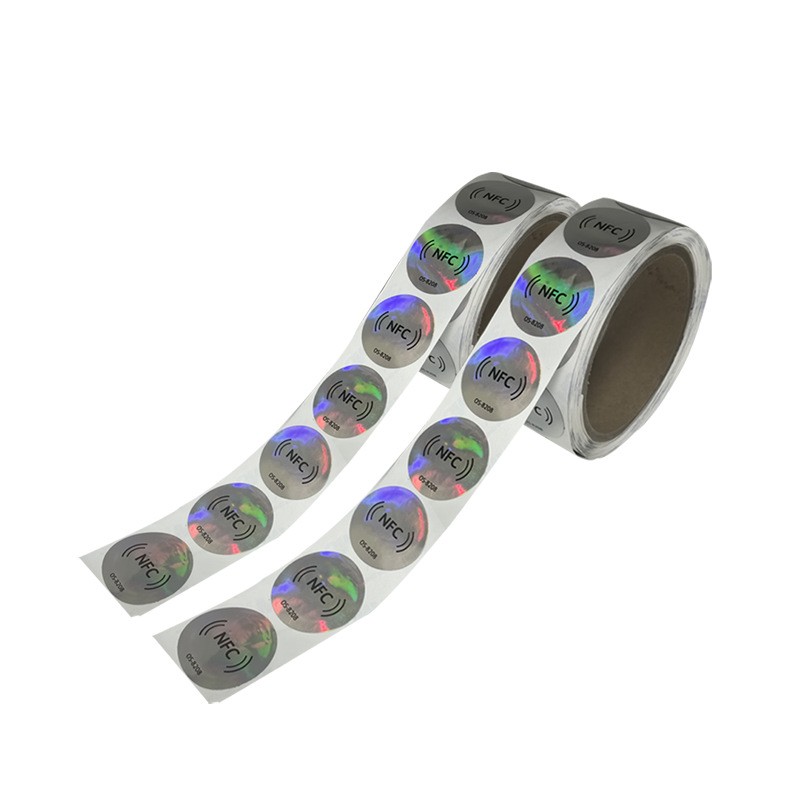
A normal sticker can be seen. This one can be read.
That is the whole distinction, and it is what separates a laser holographic NFC sticker from ordinary pressure-sensitive labelling. The holographic face provides visual authentication — a micro-embossed structure that no scanner or printer can reproduce, and which leaves evidence if removed. The embedded NFC chip provides machine authentication — a phone brought close triggers a URL, displays text, launches an app, or completes a cryptographic check.
Two channels, one label. That is why wine, cosmetics, pharmaceuticals and consumer electronics use it: visual counterfeiting is cheap to attempt and hard to prevent with print alone.
This page is structured for specification. If you are preparing an enquiry, section four is what you need.
Layer | Material and process | What it actually does |
|---|---|---|
Face stock | Laser holographic PET or PVC, micro-embossed; tamper grade available | Visual anti-counterfeiting plus removal evidence |
Print layer | CMYK offset, screen or digital; variable QR, UID or serial numbering | Branding and one-item-one-code |
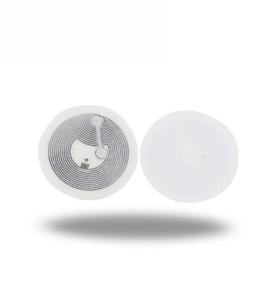
Inlay | Etched aluminium or printed silver antenna plus NFC chip | Data storage and RF response |
Adhesive | Hot-melt, water-based, removable, or high-tack | Determines which surfaces it will hold to, and whether it comes off |
The hologram is not decoration. The embossed micro-structure is optical-grade — a flatbed scan and a print run cannot reproduce it. That is the first anti-counterfeit barrier, and it costs nothing extra in the workflow.
The chip is the second. Add the chip's unique UID, and optionally cryptographic authentication, and you have a verification path that a photocopy cannot satisfy.
Tamper evidence must be specified separately — it is not the default. A standard laser face stock peels off cleanly in one piece. A tamper-evident construction delaminates on removal, leaving a VOID pattern or fractured residue on the substrate. If what you are defending against is a genuine label transferred onto a fake product, the tamper grade is mandatory. Say so at enquiry, because it changes the construction.
You do not need to read a parameter table. Answer these:
How much do you need to Store? And are you defending against copying, or against absence of a label?
Chip | Usable NDEF | Character | Typical use |
|---|---|---|---|
NTAG213 | ~137 bytes | Lowest cost, highest volume | URL redirect, short text, simple pairing |
NTAG215 | ~478 bytes | Mid capacity | Long URLs, multi-record cards, vCard |
NTAG216 | ~868 bytes | Largest capacity | Full vCard, Wi-Fi credentials, multiple records |
NTAG424 DNA | ~400 bytes | AES-128 plus SUN dynamic code | High-end anti-counterfeit, clone resistance |
MIFARE Ultralight C | ~137 bytes | 3DES authentication | Access Control, simple authorisation |
For a tap-to-open URL, NTAG213 is sufficient. It is the most compatible and the cheapest, and it covers the overwhelming majority of phone-triggered use cases.
If you are defending against counterfeiting rather than against missing labels, go to NTAG424 DNA. The UID of a standard NTAG can be cloned — UID-writable cards are widely available. The DNA family uses AES mutual authentication and generates a different ciphertext on every read (SUN), so a cloned tag fails verification. It is the only reliable choice where the threat model is a determined counterfeiter.
This is the part most often overestimated at enquiry stage, so it is worth being blunt.
What works:
iPhone — since iOS 13, the system reads NDEF in the background with no app installed. iPhone XS/XR and later support direct background tag reading; earlier models need a third-party app.
Android — the vast majority of handsets read NDEF natively and launch the browser or the relevant action without an app.
Encoding — phones can write tags using a third-party app, but batch encoding should be done on a desktop encoder. It is faster and far more consistent.
What does not work:
It is not long range. NFC is near-field. Reliable phone read distance is roughly 1–4 cm — contact or near-contact. It is not a warehouse scanning technology; that is UHF's job.
It fails on metal. Metal detunes the antenna and read distance collapses, often to nothing. If the target surface is metal, you need a ferrite absorber layer, or an on-metal NFC Tag built with one. Tell us the substrate before ordering, because this is unfixable afterwards.
Stacked labels interfere. Tags still on the roll, unseparated, will not read reliably one at a time until individually peeled.
And the most common practical problem: URL length.
NTAG213 offers about 137 bytes of usable NDEF. After the record header and URI prefix identifier, a realistic URL budget is around 130 characters. Marketing links with UTM parameters routinely exceed that and simply will not write.
Two fixes: use a short-link service, or move up to NTAG215 or NTAG216. Send us the full URL before production and we will test-encode a sample first. That one step removes the most frequent cause of rework on this product.
Size and shape — round in 25 / 30 / 35 / 40 mm diameter is standard; square and custom die-cut available. Note that antenna size drives read distance: too small and sensitivity suffers.
Chip — per section two. If unsure, describe the application and we will recommend.
Substrate — paper, plastic, glass, metal, curved surface. Metal must be declared, or the whole batch may be unusable.
Adhesive — standard high-tack, removable, low-temperature, or high-temperature. For outdoor or permanent applications the adhesive is more often the failure point than the chip.
Print — logo, text, variable QR, UID or serial numbering, and whether you need one-item-one-code.
Data service — whether we pre-encode URL, text, Wi-Fi credentials or vCard; whether you want password protection; and whether the tag should be locked read-only. Locking is irreversible — decide deliberately.
Supplied on reels for applicator machines, or cut into sheets.
Smart posters, displays and business cards — tap to open a campaign page, add a contact, download an app
Anti-counterfeit and traceability — wine, cosmetics, supplements, 3C accessories, using the holographic and digital channels together
Inspection patrol points — a worker taps the phone to check in, with time and location recorded
One-tap Wi-Fi or Bluetooth pairing — hotels, showrooms, guest networks
Asset identification — bound to a backend system, readable by both scan and tap
Interactive packaging — unboxing guidance, loyalty enrolment, warranty registration
Can an iPhone really read it with no app?
Yes, from iOS 13. iPhone XS/XR and later support background NDEF reading — bring the phone close and a notification appears. Earlier models need a third-party app.
Can it be applied to a metal product?
Not with the standard construction — it will not read. You need the on-metal version with a ferrite absorber layer. State the substrate when ordering.
Is the tag reusable?
An unlocked tag can be rewritten repeatedly. Once set to read-only it cannot be changed. Tamper-evident grades are destroyed on removal and cannot be transferred.
How long a URL can it hold?
About 130 characters on NTAG213. Longer links should use a shortener, or move to NTAG215 / NTAG216.
Minimum order and lead time?
Depends on chip, size and print process. Standard specifications are held as reel stock; custom die-cut and encrypted chips are made to order. Send the URL and substrate details and we will supply samples for testing first.
Is the substrate metal? — decides whether you need a ferrite layer. The single largest source of rework.
How long is the content? — decides whether NTAG213 is enough.
Are you preventing a missing label, or a copied one? — decides whether you need an encrypted chip.
Answer those and the specification is almost never wrong.
Contact: Adam
Phone: +86 18205991243
E-mail: sale1@rfid-life.com
Add: No.987,Innovation Park,Huli District,Xiamen,China
 Adam
Adam