
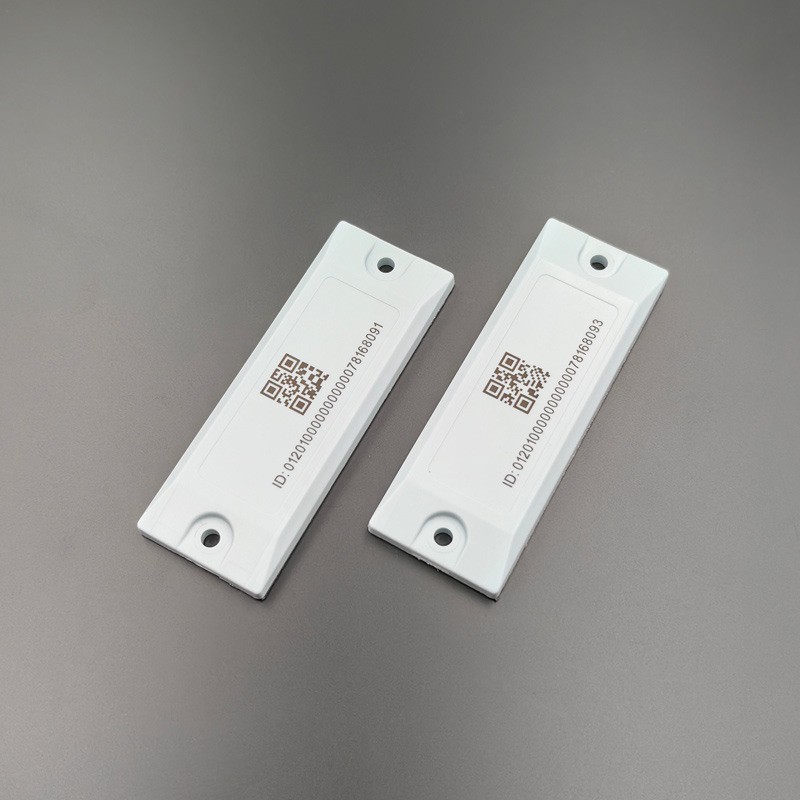
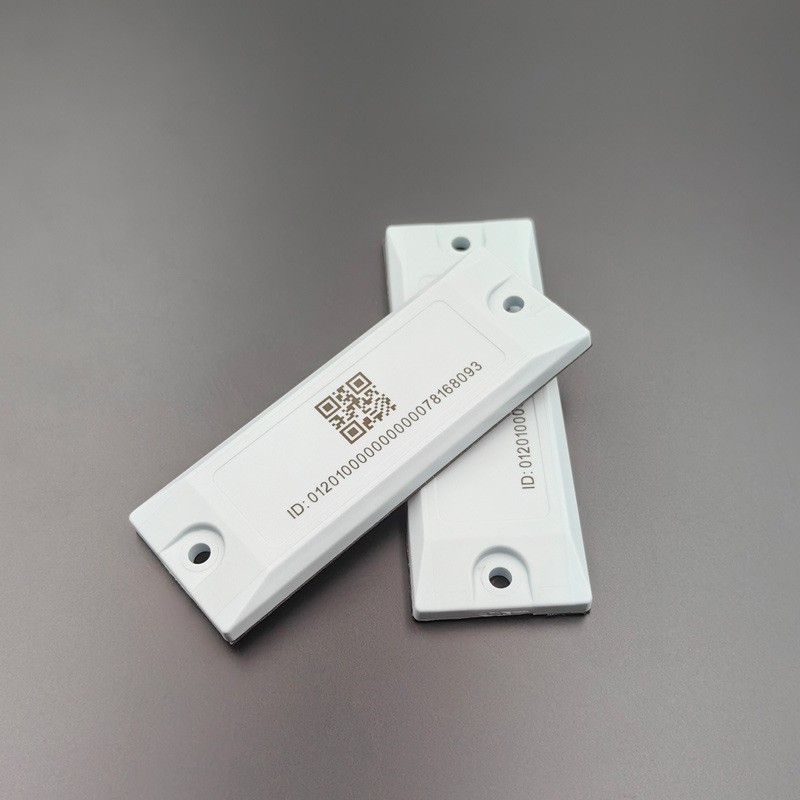
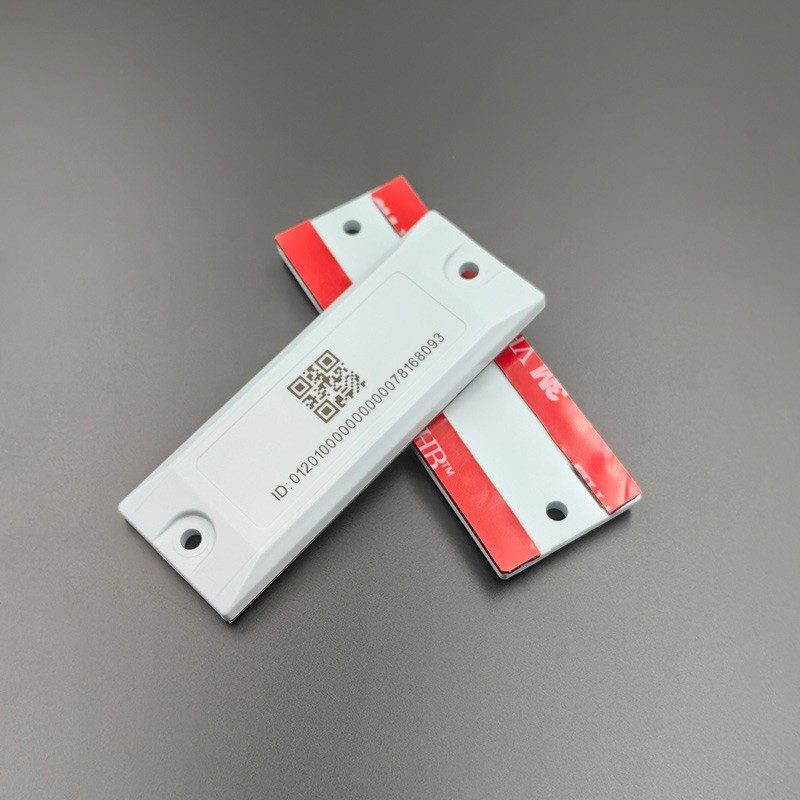
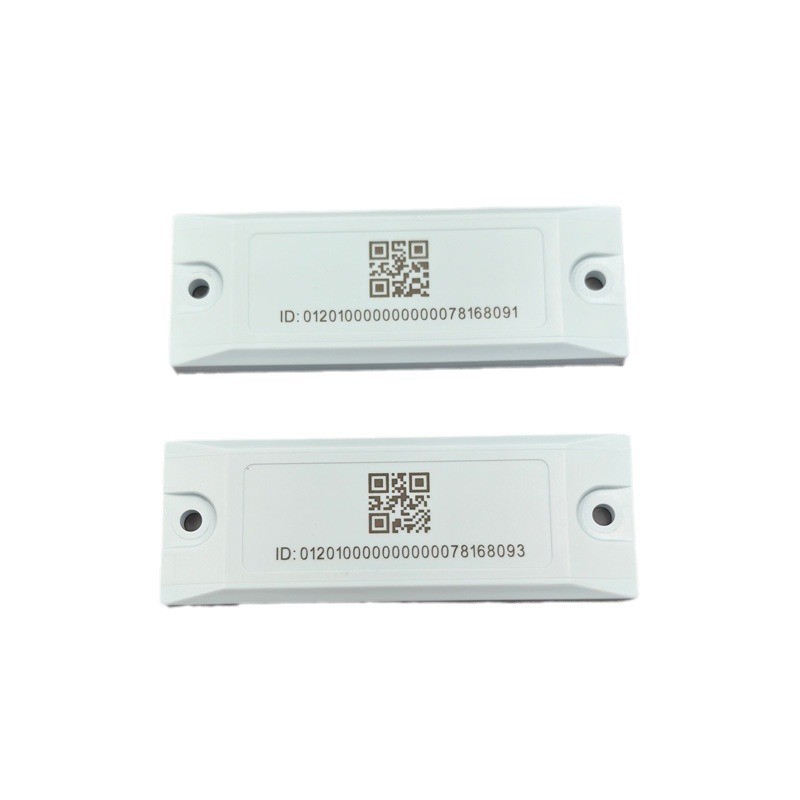
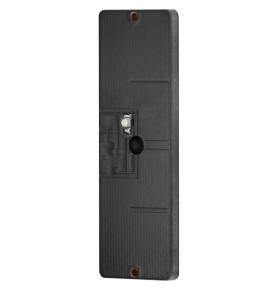
Dimensions:70 × 25 × 5 mm
Air interface:ISO/IEC 18000-6C (EPC Class-1 Gen2)
Frequency:UHF 860–960 MHz (regional band configured per destination)
Read distance:1–8 m on metal (see note below)
Data retention:10 years
Construction:ABS housing + anti-metal foam spacer + PC face stock
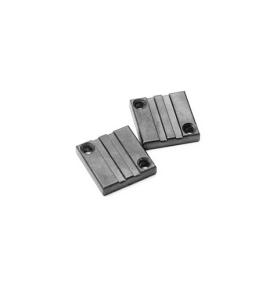
Mounting:Two Ø3.2 mm holes for screw or rivet fixing, plus high-strength double-sided adhesive
Marking:Laser or printed QR code, barcode, human-readable asset ID; custom logo
Applications:Asset management, inspection patrol, logistics, anti-counterfeit verification
Grid Asset coding has a specific problem that generic asset tagging does not: the tag is not there to help you find things. It is there to make one physical object provably identical to one entry in a national asset register — usually for decades, outdoors, on steel, with no maintenance access.
That requirement shapes everything about this tag. The narrow 70 × 25 mm format, the layered anti-metal construction, the screw holes alongside the adhesive, and the printed QR plus human-readable ID are all consequences of it.
This page covers the specification, what each layer is actually for, and how to choose between this size and the others in the series.
The series covers several formats, and they are not interchangeable. The choice is driven by the mounting surface available on the asset.
Format | Typical asset | Why that shape |
|---|---|---|
155 × 30 × 10 mm | Transmission towers, pole-mounted equipment, large outdoor frames | Long, wide surface; maximum read distance needed |
70 × 25 × 5 mm | Distribution cabinets, cable wells, ring main units, switchgear panels, narrow steel frames, pole plates | Narrow rail or frame width; needs to sit flat without overhanging |
75 × 45 × 5.5 mm | Flat cabinet doors, marshalling boxes, control panels | Larger flat area available; more print space |
58 × 58 × 5 mm | Square equipment faces, valve bodies, compact housings | Compact square footprint |
45 × 45 × 8 mm | Small castings, dense equipment clusters, curved supports | Smallest flat area; thicker for durability |
The 70 × 25 mm version is the narrow-surface format. It exists because a distribution cabinet frame, a cable-well bracket or a switchgear rail often gives you two centimetres of usable width and not a millimetre more. A wider tag either overhangs and gets struck, or cannot be fitted at all.
If the asset has generous flat area, choose a larger format — you gain read distance and print space. If it does not, this is the one.
Parameter | Value |
|---|---|
Dimensions | 70 × 25 × 5 mm |
Air interface | ISO/IEC 18000-6C (EPC Class-1 Gen2) |
Frequency | UHF 860–960 MHz (regional band configured per destination) |
Read distance | 1–8 m on metal (see note below) |
Data retention | 10 years |
Construction | ABS housing + anti-metal foam spacer + PC face stock |
Mounting | Two Ø3.2 mm holes for screw or rivet fixing, plus high-strength double-sided adhesive |
Marking | Laser or printed QR code, barcode, human-readable asset ID; custom logo |
Applications | ASSET MANAGEMENT, inspection patrol, logistics, anti-counterfeit verification |
On read distance. A quoted figure is meaningless without test conditions. The 1–8 m range for this tag is measured on a metal surface — which is the condition that matters, because it is also the condition that destroys ordinary tags. Actual range in your installation depends on reader ERP/EIRP, antenna gain, mounting orientation and the steel thickness behind the tag. Verify on the real asset before committing to a reader layout.
On data retention. Ten years refers to memory retention — how long Stored data survives without power. This is not the same as service life, and conflating the two is a common specification error. Service life is set by the housing, the adhesive and the environment, not by the chip's ability to hold bits.
The build-up is ABS + anti-metal foam + PC, and each layer does a different job. This is not decorative.
The foam spacer is the functional one. A conventional UHF tag placed flat on steel suffers severe detuning: the metal induces eddy currents and reflects energy back into the antenna, shifting its resonance. The symptom is not a clean failure but a collapse in read range — often to zero. The foam is a dielectric spacer. It holds the antenna at a controlled distance from the metal so the tag sees a manageable electromagnetic environment instead of a shorting plane. Thicker spacer generally buys more read distance at the cost of more thickness — which is why this tag is 5 mm rather than sub-millimetre.
ABS provides impact resistance and dimensional stability across temperature swings. It takes a screw without cracking and survives the knocks that field equipment receives.
PC face stock takes the print. It holds a laser-marked or printed QR, barcode and human-readable ID legibly for years outdoors, and it resists the yellowing and chalking that defeat paper and thin PET facestocks under continuous UV.
The tag gives you two mounting methods and you should use both.
Two Ø3.2 mm holes — screw or rivet fixing. This is the retention that survives vibration, thermal cycling, pressure washing and adhesive ageing.
High-strength double-sided adhesive — holds the tag in position while it is being fixed, and provides immediate bond on smooth surfaces.
Adhesive alone is not adequate outdoors. Repeated thermal expansion and contraction is what breaks adhesive bonds — not peak temperature, but the cycling. A tag that detaches inside a cabinet becomes debris, and in a power environment loose conductive debris inside switchgear is a genuine problem, not just a data gap. Screw or rivet it, and treat the adhesive as installation convenience.
For curved surfaces or where drilling is prohibited, the adhesive plus a steel band or cable tie is the fallback — but it should be an explicit decision, not a default.
Every tag carries a printed QR and a human-readable asset ID in the grid unified identity code format. That number is the asset's identity in the register, and it is what makes the physical object and the database record the same thing.
Two rules govern how it should be used:
The ID must be the primary key. If a deployment runs a separate "RFID number" in parallel with the operational asset code, reconciliation becomes a permanent manual chore and the system quietly stops being trusted. One identifier, one owner.
Keep the human-readable fallback. The printed QR and ID mean a dead reader battery at a remote site does not end the job. It also means an inspector can cross-check a read against the label when a discrepancy needs resolving.
For encoding structure and security requirements — including whether tags on primary equipment need to withstand power-frequency field, transient overvoltage and impulse testing — refer to the industry tag specification applicable to your grid. That is a qualification question, not a printing question, and it should be settled before ordering.
Asset management — the register entry and the physical object stay provably linked across transfers, retrofits and staff turnover
Inspection patrol — an attributable read at the asset proves presence, which is the difference between a completed inspection and a signed-off one
Logistics — inbound verification, warehouse issue, and installation confirmation
Anti-counterfeit verification — a serialized, register-bound identity that a copied label cannot satisfy
Confirm the regional band — ETSI, FCC or SRRC/MII. This determines the chip and antenna tuning and cannot be changed after production.
Confirm the asset and mounting surface — flat steel, curved, painted, galvanised. This drives whether the standard foam thickness is correct.
Confirm the coding — the ID format, whether you supply the number list, and whether one-item-one-code is required.
Confirm the marking — QR, barcode, logo, human-readable ID, and whether laser or print.
Confirm the quantity and whether samples are needed for field testing — always worthwhile for a first deployment.
What is the read distance on metal?
1–8 m, measured on a metal surface. Actual range depends on reader power, antenna, orientation and the steel behind the tag — verify on the real asset.
Can it be mounted on curved surfaces?
Mild curvature is workable with adhesive. Tight curvature needs banding rather than screws. State the radius when ordering.
Is it only for power applications?
No. The anti-metal construction and narrow format suit any narrow steel asset — machinery frames, racking, containers, cable trays. The grid asset code printing is specific to power.
Can the number be supplied as a list?
Yes. Send the ID list and one-item-one-code can be applied, with each tag's EPC mapped to its printed ID.
What does 10-year data retention mean?
Memory retention without power. It is not a service-life guarantee — service life depends on housing, adhesive and environment.
Screws or adhesive?
Both. Screws or rivets through the Ø3.2 mm holes for retention; adhesive for positioning and immediate bond. Adhesive alone is not recommended outdoors.
Internal links:
Power and utility asset management framework → RFID-power-utility-asset-management
Inspection programme design → UHF-RFID-power-inspection
Substation deployment → RFID-substation-asset-tracking
Outdoor enclosure and anti-metal selection → outdoor-anti-metal-RFID-tag
Frequency and chip differences → HF-UHF-industrial-tags
Contact: Adam
Phone: +86 18205991243
E-mail: sale1@rfid-life.com
Add: No.987,Innovation Park,Huli District,Xiamen,China

 Adam
Adam