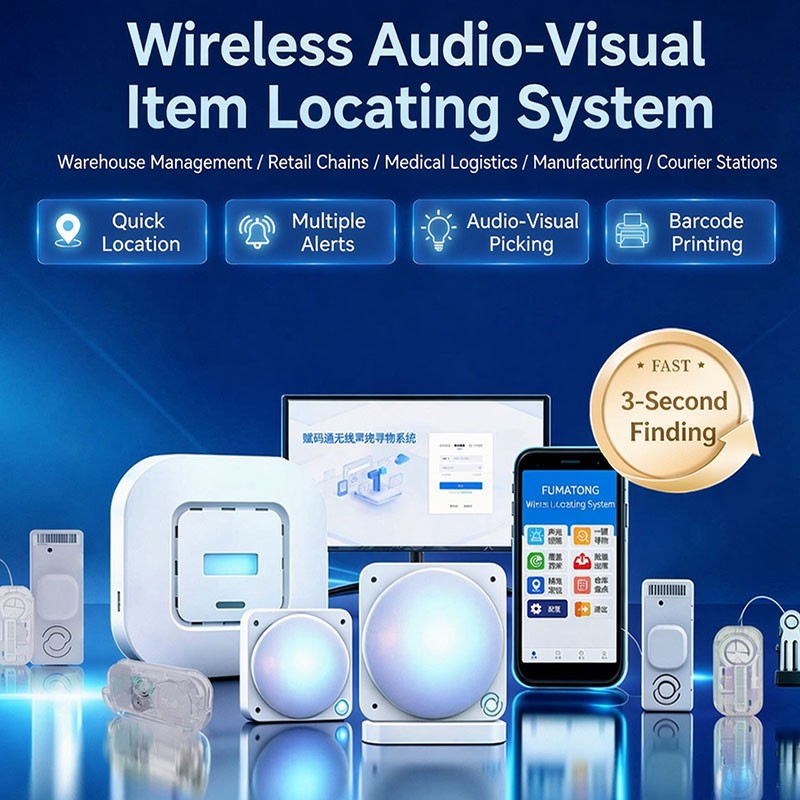
This proposal describes a wireless audio-visual item locating system for warehouses, parcel stations, hospital wards and pharmacies, and fixed-asset management. The system combines audio-visual electronic labels, fixed base stations, a management backend and a handheld PDA. It guides operators to the exact bin by light and sound, and records every locating, inbound and outbound operation in the backend.
WIRELESS AUDIO-VISUAL ITEM LOCATING SYSTEM
RFID-Enabled warehouse, Parcel-Station, Pharmacy and Fixed-Asset MANAGEMENT Solution
Location Management · Inbound / Outbound · Bin Locating · Asset Tracking
Technical Proposal
Version: EN-2026-10
Note: All product model numbers, hardware specifications, performance data and application statements are taken from the supplied marketing materials. Battery life, communication range and search response times are manufacturer-specified values; actual performance depends on the operating environment, quantity of labels and configuration. They should be confirmed during acceptance testing.
This proposal describes a wireless audio-visual item locating system for warehouses, parcel stations, Hospital wards and pharmacies, and fixed-asset management. The system combines audio-visual electronic labels, fixed base stations, a management backend and a handheld PDA. It guides operators to the exact bin by light and sound, and records every locating, inbound and outbound operation in the backend.
The solution addresses four recurring problems:
· Disorganized goods and slow manual counting in warehouses and parcel stations.
· Difficulty finding emergency supplies, medical devices and medicines quickly in wards and pharmacies.
· Delayed inventory records and fragmented location data caused by manual stocktaking.
· Lost or misplaced Tools, documents and public assets in factories, offices and campuses.
It supports nine application scenarios: warehouse, hospital ward/pharmacy, supermarket/retail, property park, government/enterprise archive room, office building, hotel/B&B, campus and factory workshop.
Source: supplied application-scenario materials (warehouse/pharmacy, supermarket/retail, office/hotel/campus/factory).
· Bind every item or pallet to a location (bin/shelf layer) and identify it through barcode or RFID.
· Locate goods, totes and pallets quickly over short and long distances.
· Support inbound, outbound, replenishment, stocktaking and transfer with operation logs and traceability.
· Bind parcels to shelf bins so staff and customers can find them by one-touch audio-visual prompting.
· Keep bin status and retention records up to date, and prevent missed or wrong pickups.
· Provide station managers with an overview of bin occupancy and exception alerts.
· One-touch wake-up of emergency devices, medical consumables and escort beds.
· Prevent loss of devices and medicines while reducing manual searching by nursing staff.
· Keep usage logs for auditable, compliant management.
· Locate office equipment, archives, teaching and laboratory instruments, tools and workwear in real time.
· Replace delayed manual counts with on-demand location checks.
· Maintain return and usage records for every asset.
The system consists of four layers:
Layer | Components | |
Presentation | Management backend (web); Mobile app on PDA | |
Communication | fixed base station | |
Identification | slot/clip light strip; magnetic light; spherical beacon | |
Integration | Optional ERP/WMS/HIS/asset system interface |
Working principle (based on supplied description): scan the label barcode, bind it on the PDA, and send a locating command. The base station forwards the command to switch on the electronic label's LED and buzzer. This guides pickers to the exact item quickly. The supplied materials position this architecture for small and medium-sized warehouses.
Standard operation flow:
· Binding: scan the label ID and the item barcode/QR code to bind item and label one by one.
· Locating: enter the item number or scan the physical barcode; the associated label is triggered within seconds.
· Inbound: assign a target bin, call the bin label and confirm placement on the PDA.
· Outbound: call the pick bin, confirm retrieval and update the backend stock record.
· Stocktaking: call labels by zone, confirm on site and reconcile with backend data.
· Return/transfer: change the bound location or owner and keep the log.
· Shelf-layer slot light strips for bin positioning; clip-on labels for totes, pallets and movable items.
· Core advantage: solves disorganized goods, slow counting and long search time; greatly improves inbound/outbound efficiency.
· Application highlight: audio-visual label prompts for goods, totes and pallets; fast long-distance search for small and large warehouses.
· Bind each locker/shelf bin to a label; staff or customers enter the parcel number on the PDA or app to trigger the bin light and buzzer.
· Core advantage: replace manual shelf-by-shelf searching and reduce misdelivery and waiting time.
· Application highlight: 24/7 self-pickup support, bin-status monitoring and retention-time alerts (to be confirmed during implementation).
· Magnetic or slot lights on medicine shelves and ward cupboards; clip lights on mobile carts and escort beds.
· Core advantage: ensures emergency supplies are taken in time, avoids loss of devices and medicines, and reduces workload for medical and nursing staff.
· Application highlight: one-touch audio-visual wake-up of emergency equipment, medical consumables and escort beds for immediate access in emergencies.
· Clip labels on tools and instruments; magnetic or slot lights on cabinets and shelves.
· Core advantage: on-demand asset positioning; solves the lag of manual counts and isolated location data.
· Application highlight: location query, return reminder and usage/log audit for tools, instruments, documents and equipment.
Parcel-station, self-pickup and retention-alert functions are extensions of the supplied locating and binding capabilities; they require confirmation of software configuration and interfaces.
Other supported scenarios (from supplied materials):
Scenario | Core Advantage | |
Supermarket / Retail | Optimise front-Store and backroom goods management; shorten replenishment and search time | |
Property Park | Strengthen fire-safety, patrol and emergency-material control; meet safety requirements | |
Government/Enterprise Archive Room | Protect classified archives and vouchers; locate Files accurately; ensure compliance | |
Office Building | Standardise public-material management; prevent random placement and loss; improve office efficiency | |
Hotel / B&B | Unified management of linen, tools and materials; reduce asset loss; improve room-service efficiency | |
Campus | Control teaching and Sports equipment; reduce loss; convenient for staff, students and logistics | |
Factory Workshop | Real-time tracking of workwear and parts; avoid lost tools and messy workbench materials |
Model / Name | Key Specifications |
fixed base station | 190 (H) x 190 (V) x 41 (D) mm; 360 g; standard RJ45 network port; USB 2.0 configuration port; open-area communication distance >=30 m |
magnetic light | 82.47 x 33.97 x 21.9 mm; 1100 mAh battery; magnetic mounting (standard accessory); button life >=100,000 operations; open-area distance >=30 m |
slot light strip | 65.80 x 31.30 x 12.3 mm; 550 mAh battery; mounted by 3.5 mm screw, magnetic backplate or adhesive; button life >=100,000 operations; open-area distance >=30 m; can be clipped on (standard accessory) or used as shelf locator |
spherical beacon | 87 x 87 x 52 mm; 4000 mAh battery; magnetic mounting; button life >=100,000 operations; open-area distance >=30 m |
PDA locator | 156 x 75 x 14.5 mm; 3.85 V / 5000 mAh battery, 18 W fast charging; octa-core 2.0 GHz CPU; Android 11.0; 3 GB LPDDR3 (4 GB optional) |
Label battery claim (supplied): battery life exceeds one year based on 6 minutes of flashing per day.
Deployment references from supplied materials:
· Fixed base stations can be ceiling-mounted to cover shelving aisles.
· Slot light strips can be installed in shelf slots for bin-level positioning.
· Magnetic lights can be installed on metal cabinets and racks.
· Clip light strips can be attached to tools, bags and movable assets.
· Spherical beacons can be used as bin lights in large storage areas.
Management backend:
· Real-time monitoring of base-station network topology and label online status, including battery and signal strength.
· Remote 'call label' command to activate the selected label's audio-visual prompt.
· Operation log and response-time recording for every call, supporting audits and stocktaking.
Mobile app (PDA):
· One-scan binding of label ID with item barcode/QR code.
· Precise audio-visual call: enter the material number or scan the physical barcode to trigger the associated label within seconds.
· Inbound, outbound, stocktaking and query operations, with offline caching if required (to be confirmed).
Phase | Duration (reference) | ||
1. Survey | Week 1 | ||
2. Design & configuration | Week 2 | ||
3. Installation | Week 2-3 | ||
4. Testing | Week 3-4 | ||
5. Training & go-live | Week 4 | ||
6. Operation | Ongoing |
The above durations are reference estimates. They should be adjusted according to site scale and integration requirements.
· Communication coverage: call success rate at every labelled bin under normal operating conditions.
· Locating accuracy: the called label matches the target item/bin.
· Response time: trigger-to-light/buzzer time for a defined sample of labels (success criterion to be agreed).
· Backend functions: online status, operation log and response-time records are complete.
· Integration: inbound/outbound documents are synchronised correctly with the existing system.
· Battery and installation: labels are securely fixed and accessible for replacement.
· Warranty and replacement policy: to be specified in the commercial contract.
· Remote technical support and on-site support scope.
· Regular label-battery and base-station health checks through the backend.
The Bill of Materials below is a reference structure. Actual quantities depend on the number of bins, items, shelving layers and site layout. RFID Readers, tags, servers, network equipment and integration work are not listed in the supplied materials; they should be added according to the confirmed design.
No. | Item | ||||
1 | Fixed base station | ||||
2 | Slot light strip | ||||
3 | Clip light strip | ||||
4 | Magnetic light | ||||
5 | Spherical beacon | ||||
6 | Locator PDA | ||||
7 | Management backend & mobile app | ||||
8 | RFID devices / tags | ||||
9 | Installation & commissioning | ||||
10 | System integration | ||||
Total |
Payment terms, delivery time, warranty and support scope: to be agreed in the contract.
Next steps:
· Confirm business priorities (warehouse, parcel station, pharmacy or fixed assets) and required system interfaces.
· Conduct an on-site survey and issue a bin-coding and device-layout plan.
· Agree acceptance criteria and a detailed quotation based on the Bill of Materials.
· Sign the contract and start deployment.
We look forward to discussing this proposal and tailoring the solution to your operation.
Disclaimer: This document is a translation and structured reorganisation of the supplied Chinese materials. It does not add independent performance guarantees or third-party certifications. All technical and commercial items should be confirmed with the vendor before ordering.
Contact: Adam
Phone: +86 18205991243
E-mail: sale1@rfid-life.com
Add: No.987,Innovation Park,Huli District,Xiamen,China


 Adam