
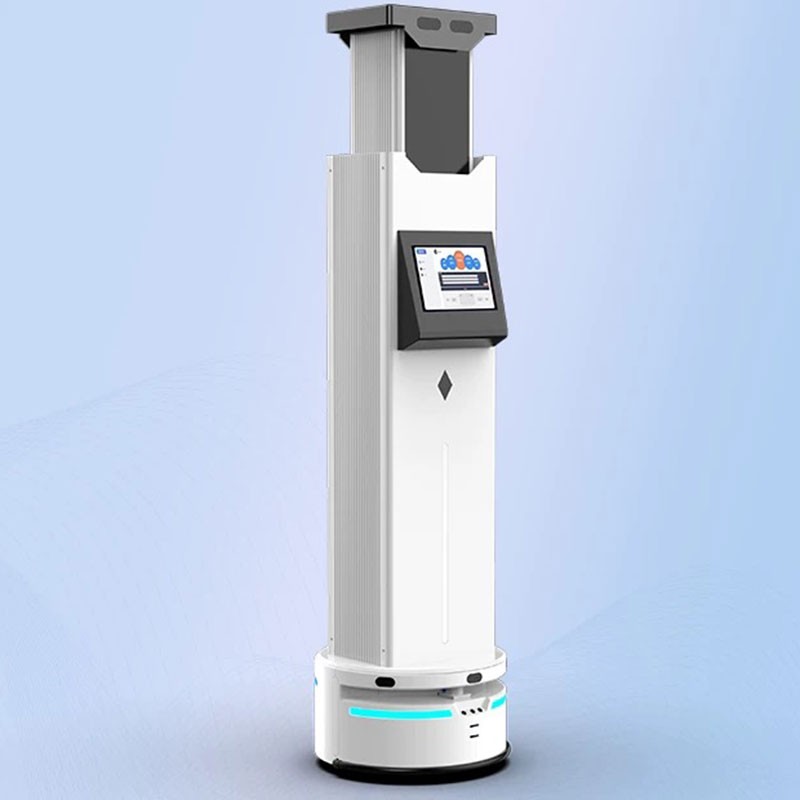
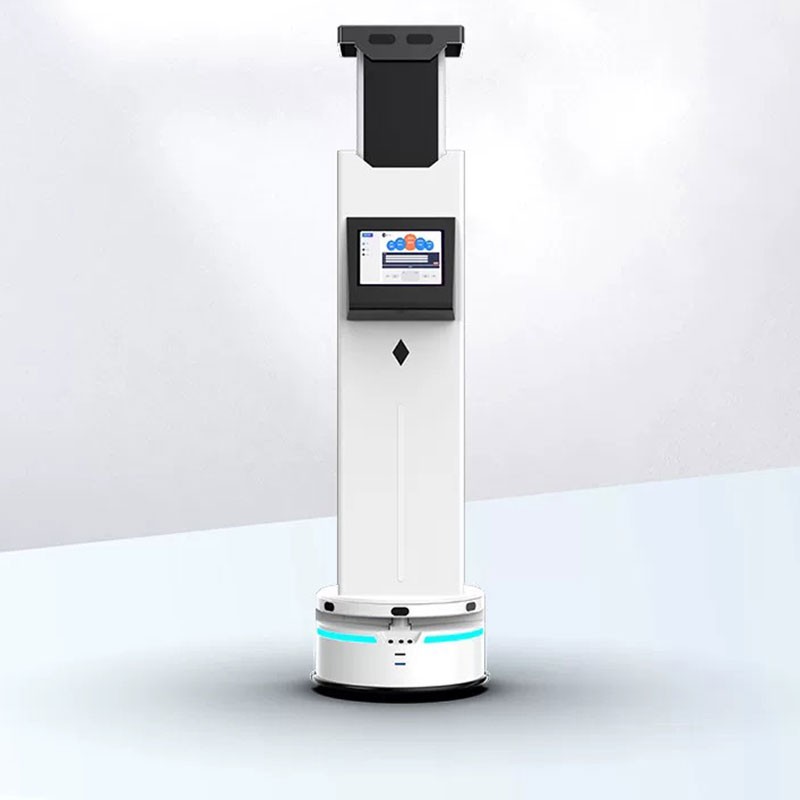
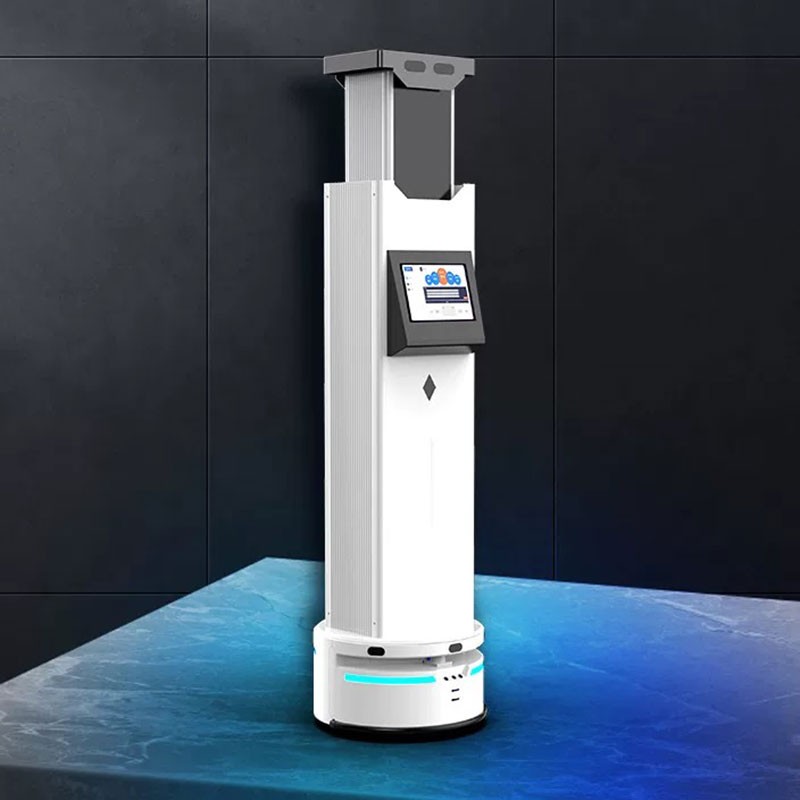
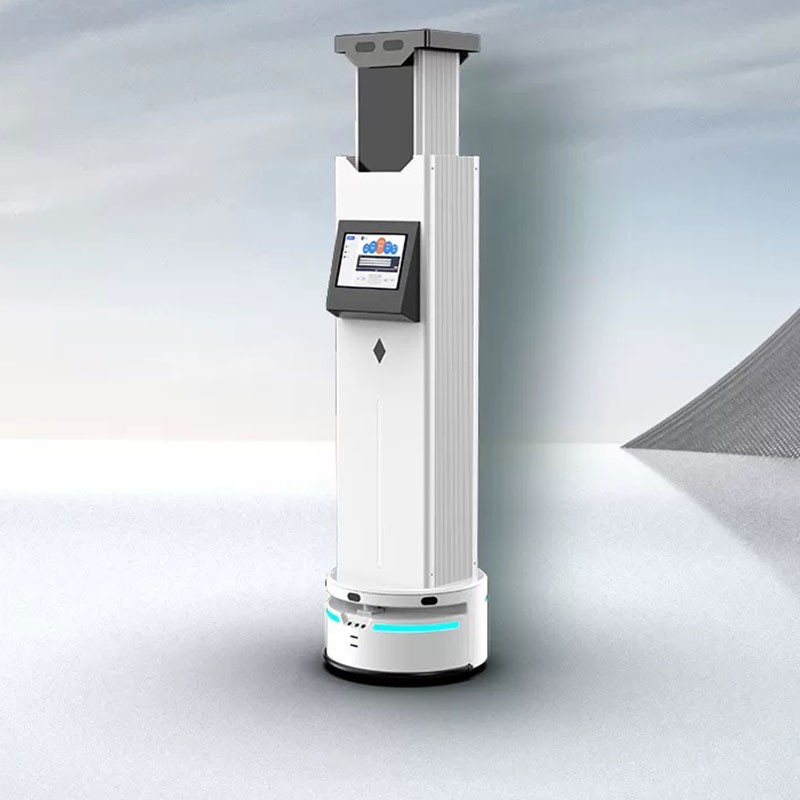
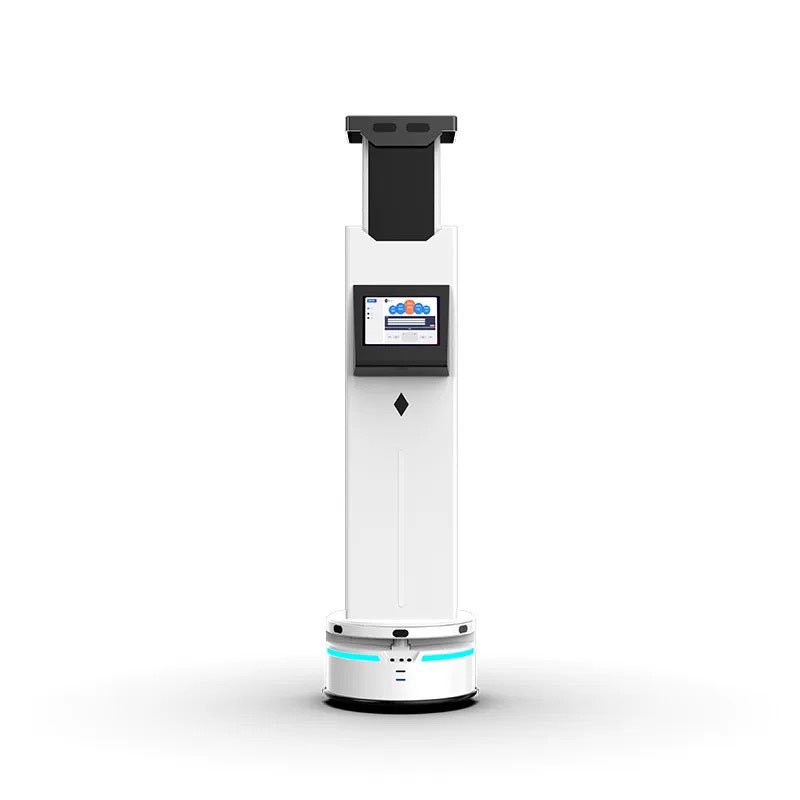
The Library Robot Chassis is a high-performance, fully integrated mobile base designed for building autonomous service robots across commercial and industrial scenarios. It combines laser-LiDAR SLAM localization, a 3D depth camera, IMU, and ultrasonic sensors into a tightly coupled multi-sensor fusion pipeline, powered by proprietary SLAM navigation system.
The Library Robot Chassis is a high-performance, fully integrated mobile base designed for building autonomous service robots across commercial and industrial scenarios. It combines laser-LiDAR SLAM localization, a 3D depth camera, IMU, and ultrasonic sensors into a tightly coupled multi-sensor fusion pipeline, powered by proprietary SLAM navigation system.
Key differentiators:
Advantage | Description |
|---|---|
No landmark / no QR-code required | Pure laser+visual SLAM — navigate freely without floor markers |
Dynamic path re-planning | Reacts to moving people & changing environments in real time |
Ultra-long runtime + auto-docking | Large-capacity Li-ion pack with low-battery autonomous return-to-charge |
Heavy-payload compact footprint | Ø450 mm circular form factor, up to 50 kg payload, net weight only 30 kg |
Open development platform | HTTPS / WebSocket APIs + SDK for custom application layers |
The chassis is engineered for retail, supermarkets, office buildings, Hospitals, exhibition halls, government service centers, transit hubs (stations/airports), Restaurants, hotels, and light logistics transport.
LiDAR + 3D Camera + IMU + Ultrasonic multi-sensor fusion for omnidirectional safety
Laser SLAM mapping & localization — supports map creation, modification, virtual wall setup, and map switching
Dynamic obstacle avoidance: real-time stop or detour around people/objects
Path planning: autonomous optimal routing or manually defined waypoint paths
Battery: 38 V · 25 Ah high-density Li-ion pack
Typical endurance: ≈10 hours (no-load)
Built-in BMS: over-charge protection + low-temperature charging self-heating
When charge drops below a configurable threshold → robot autonomously returns to charging dock
Adapter / charger input: 100–240 V AC wide-range
Built-in multi-robot autonomous dispatch
Dynamically adjusts speed and delivery paths by task priority
Enables orderly operation of multiple chassis in shared spaces
Exposes HTTP / HTTPS & WebSocket protocol interfaces
Rich RESTful API set for:
Navigation commands & waypoint CRUD
Task scheduling & periodic jobs
Real-time telemetry (pose, battery, fault codes)
Remote joystick / teleop control
On-board compute unit + RJ45 Ethernet + dual-band Wi-Fi (2.4 GHz / 5 GHz)
Item | Parameter |
|---|---|
Model | C50 |
Form Factor | Circular chassis |
Overall Dimensions | Ø 450 × H 317 mm (450 × 450 × 170 mm) |
Net Weight | 30 kg |
Max. Payload | 50 kg |
Ground Clearance | 33 mm |
Min. Passage Width (narrow corridor) | ≥ 70 cm |
Rated System Power | 60 W (typical operating) |
Cruising Speed | 0.3 – 1.0 m/s (software-adjustable) |
Emergency Stop | Hardware E-Stop button — supported |
Power Switch | Dedicated ON/OFF key |
Item | Parameter |
|---|---|
Battery Type | Lithium-ion, high-density |
Battery Rating | 38 V / 25 Ah |
No-Load Endurance | ≈ 10 hours |
Protection Features | Over-charge protection; low-temp self-heating during charge |
Charging Method | Auto-docking to charging station (auto-return when low) |
Adapter Input | 100 – 240 V AC |
Charging Station Input | 100 – 240 V AC |
User Power Output | DC 24 V 10 A / DC 24 V 10 A (dual output rails for payload accessories) |
Sensor | Detail |
|---|---|
LiDAR (Single-Line) | • Scan angle: 230° front arc |
3D Depth Camera | • Mount position: Front-facing |
IMU (Inertial Measurement Unit) | Angular precision: 0.01° |
Ultrasonic Sensors | Supplemental close-range detection (bumper-zone safety) |
Item | Parameter |
|---|---|
Drive Configuration | 2 × hub-motor driven wheels (differential / omni capable per firmware) |
Hub Motor Size | 5.5 inch |
Motor Voltage | 24 V (driven via internal DC/DC from 38 V pack) |
Caster / Free Wheels | 4 × universal casters |
Suspension | Pendulum-type active suspension (helps maintain traction over small thresholds / uneven floors) |
Interface | Specification |
|---|---|
Ethernet | RJ45 (wired LAN for docking stations / backbone) |
Wi-Fi | 2.4 GHz & 5 GHz dual-band |
Protocol / Dev Access | HTTPS + WebSocket · Open SDK · RESTful API |
Power Rails for Payload | 2× DC 24 V / 10 A terminals |
Internal Compute | On-board controller running SLAM & navigation stack |
# | Function | Description |
|---|---|---|
1 | Autonomous Patrol / Navigation | Follows autonomously planned shortest paths or user-defined routes along waypoints |
2 | Multi Waypoint Setup | Define multiple stops within mapped area; reorder sequence freely; iterate through them |
3 | Navigation Task Scheduling | Create named tasks (each = ordered waypoint list); assign periodic / timed schedules or trigger on-demand |
4 | Dynamic Obstacle Avoidance | Detects obstacles via LiDAR + 3D camera + ultrasonics → live detour or controlled stop |
5 | Auto-Charging Cycle | Monitors SoC; below threshold → pause task → navigate home to docking station → charge → resume |
# | Function | Description |
|---|---|---|
1 | Speed ProFiles | Per-task or global speed limit configuration (0.3–1.0 m/s envelope) |
2 | Remote Teleoperation | Manual drive / pause / resume through web-based management console |
3 | Map Management | Create · Edit · Swap · Rebuild maps · Add virtual walls (keep-out zones) |
4 | Task Dispatch | Calendar-based recurring dispatches or real-time push commands |
5 | Data Logging | Navigation telemetry + event logs Stored locally (and/or forwarded to server) |
6 | System Configuration | Network settings, battery thresholds, safety limits, E-stop behavior |
7 | Remote Monitoring | Live robot state dashboard; fault/alarm push; remote diagnostics |
8 | Remote Deployment | Map an entire site remotely — scan, draw walls, drop waypoints, all over network |
9 | Cross-Zone Dispatching | Single control panel manages robots across physically separated areas |
Qty | Item |
|---|---|
×1 | C50 Chassis (main body) |
×1 | Battery charging adapter / PSU |
×1 | Auto-docking charging station |
— | Power cable & data cable set |
(Upper-module options — such as delivery bins, touchscreen mast, UV modules, or tray decks — are available as payload add-ons / customization services.)
Sector | Example Use |
|---|---|
New Retail / Supermarkets | Shelf patrol, promo-screen mobile kiosks, goods-to-person transport |
Office Buildings / Hotels | Document / amenity delivery, security patrol, reception guidance |
Hospitals / Clinics | Lab specimen runs, linen/logistics loops, non-contact transport |
Exhibition Halls / Gov. Centers | Guided tour base, information-point roving, queue management |
Stations / Airports | Announcement-rover, cleaning-base integration, wayfinding |
Restaurants / Catering | Bussing / dish-bin runs, sealed-food transport (payload-dependent) |
Light Logistics | Intra-floor material movement between workcells |
纯文本纯文本┌────────────────────────────┐
 │  3D Camera (front)          │  ← near-field depth / stairs-drop caution
 │  LiDAR 230° (front arc)     │  ← SLAM geometry & long-range obstacle
 │  Ultrasonic ring             │  ← bumper safety curtain
 │  IMU                         │  ← odometry drift correction
 └──────────┬───────────────────┘
            ▼
      ┌──────────────┐
      │  Compute Unit │── Ethernet / Wi-Fi ──→ Fleet Manager / Cloud
      │  SLAM Engine  │           ↑
      │  Path Planner │    HTTPS / WebSocket API (SDK)
      └──────┬───────┘
             ▼
      ┌──────────────┐
      │ Motor Drivers│ → 2× 24 V Hub Motors + 4× casters
      │ 24↔38 V PMU  │ → 38 V 25 Ah pack (BMS, heating)
      └──────────────┘
This high-performance series of RFID Readers utilizes an all-digital signal processing design with completely independent intellectual property rights. Fully compliant with the ISO/IEC 15693 protocol, these readers incorporate proprietary anti-collision algorithms that ensure high read rates while enabling rapid data processing. They are ideally suited for a wide range of applications including unattended retail, smart shelves, logistics, personal identification, conference attendance systems, Access Control, anti-counterfeiting, and production process control.
Advanced Design: Full digital signal processing design requires no manual adjustment.
Protocol Support: Compliant with ISO/IEC 15693 standards; supports transparent command format operations.
RF Performance:
Frequency: 13.56 MHz. read NXP ICODE SLIX/SLIX2
Output Power: Adjustable from 0.5W to 5W (Peak 7W).
Read Range: Up to 50cm or greater, depending on the antenna and environment.
High-Speed Processing: Features advanced anti-collision algorithms achieving typical processing speeds exceeding 80 tags per second.
Multi-Antenna Configuration:
Ports: Available in configurations with 1, 4, 8, 12, 16, 20, 24, 32, or 36 SMA antenna ports.
Compatibility: Directly interfaces with standard 50Ω RFID Antennas.
Management: Supports individual port status detection and combined inventory operations.
Connectivity:
Standard RS232 interface with optional TCP/IP support.
Software-adjustable communication baud rate.
Development Support: Provides Dynamic Link Library (DLL) files and demonstration source code to facilitate secondary development.
Physical & Power: Compact, aesthetic design with low-power consumption; operates on a 24V DC power supply.
Unattended Retail, Smart Shelves / library Management, Logistics & Supply Chain, Personnel Identification, Conference Check-in Systems, Access Control Systems, Anti-Counterfeiting Systems, and Industrial Production Process Control.
Contact: Adam
Phone: +86 18205991243
E-mail: sale1@rfid-life.com
Add: No.987,Innovation Park,Huli District,Xiamen,China
 Adam
Adam