
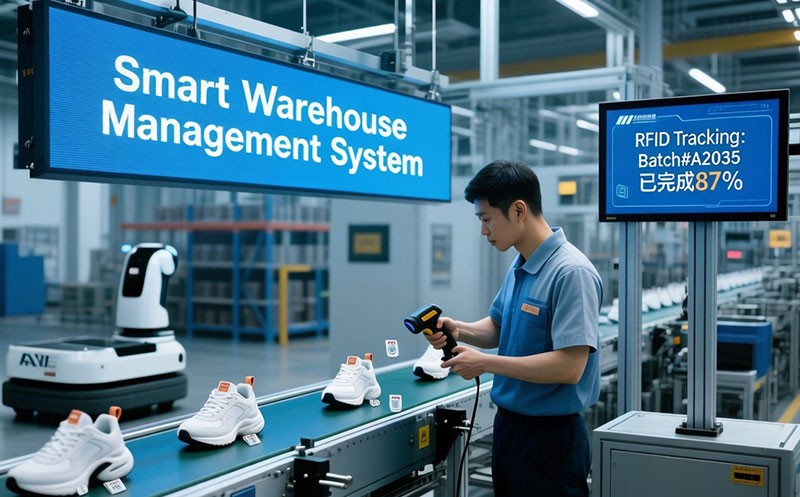
As a typical labor-intensive industry, shoe factories are facing growing demands for personalization and a rapidly changing market environment. Current production management in shoe factories presents the following prominent pain points:
| Pain Point Type | Specific Manifestation | Business Impact |
|---|---|---|
| Data collection Delay | Barcodes require manual scanning item by item, with data collection delay rates exceeding 12% | Disconnect between production scheduling and actual progress |
| Severe Tag Damage | Dust, glue erosion, and handling friction in packaging workshops cause damage rates of over 25% for paper labels | Broken traceability chain |
| High Incorrect Assembly Rate | Mixed-line production of multiple styles and sizes leads to incorrect size assembly and missing accessories, with error rates climbing to 4% | Severely impacts delivery efficiency |
| High Manual Dependency | Processes like traditional deburring rely heavily on manual operations, resulting in low efficiency and susceptibility to errors | Poor quality stability |
| Inventory Blind Spots | Lack of transparency in semi-finished and finished goods inventory | Difficulty adjusting production plans |
The RFID shoe factory solution consists of a three-layer architecture:
text
┌─────────────────────────────────────┐
│     Application Layer: MES/WMS/ERP Systems      │
├─────────────────────────────────────┤
│        Network Layer: industrial Ethernet/Wi-Fi       │
├─────────────────────────────────────┤
│ Perception Layer: RFID Readers, Electronic Tags, Antennas │
└─────────────────────────────────────┘
Shoe factory environments have specific requirements for RFID equipment. The following industrial-grade products are recommended:
| Device Type | Recommended Model | Key Features | Application Scenario |
|---|---|---|---|
| HF Reader | FR08 Series | 13.56MHz, compliant with ISO15693, IP67 protection level, supports modbus TCP/Profinet/EtherNet/IP | Last processing, Deburring stations |
| LF Reader | LR08 Series | 134KHz, supports FDX protocol, IP67 protection level, 3-in-1 integrated design | Harsh industrial environments |
| Industrial Read Head | Customized | Integrated antenna, amplifier, controller | Automated production line integration |
| RFID Tunnel Machine | Checkpoint RFID Tunnel | RFID shielding function, isolates surrounding signal interference, precise batch reading verification | Finished product outbound,装箱 verification |
The shoe last is the core of the shoemaking process, directly affecting the quality of the finished shoe. In the last processing stage, the application of RFID technology includes:
Tag Embedding: Install electronic tags into the shoe last, writing key information such as last type, size, and left/right foot via RFID Readers
Unique Identification: Each shoe last obtains a unique digital identity, facilitating full lifecycle tracking
Processing Monitoring: Install readers at key工序 to monitor last processing progress and status in real-time, with data automatically uploaded to the MES system
In the initial stage of upper processing, establish a digital File for each pair of shoes:
Tag Selection: Use wear-resistant, dust-and-corrosion-resistant RFID tags that can withstand harsh conditions in the packaging workshop, significantly reducing tag damage rates
Data Writing: Input key data such as style, size, color, and customization requirements
Process Linkage: When shoes流转 to various nodes on the production line, readers automatically读取 tag information,联动 adjusting the production path and synchronously下发 parameter instructions to processing equipment, accurately matching stitching and bonding processes
In processes like deburring, RFID technology is deeply integrated with automated equipment:
Automatic Identification: RFID tags are fixed on the shoes, with readers installed on the production line. When shoes pass by, tag information is automatically read
PLC Integration: The reader transmits information to the PLC system, which controls the operating parameters and processing of the equipment, enabling automated processing
Real-time Monitoring: Real-time monitoring and analysis of production data through the MES system allows for timely adjustment of production plans and optimization of production processes
At the packaging station, RFID technology is deeply integrated with PLC programs:
Automatic Sorting: When shoes and accessories arrive at the packaging station, readers automatically读取 tags and transmit data to the PLC system, controlling equipment to complete automated sorting, matching, and packaging verification
Error Prevention: Reduce incorrect size assembly and missing accessories from the source, aiming to降低 the error rate to below 1%
Data Collection: Data from the packaging stage is automatically collected, virtually eliminating delays
In the finished goods warehousing stage, RFID technology greatly enhances efficiency:
Batch Reading: Using RFID tunnel machines, entire boxes of products can be入库 with one click by passing through a dedicated channel, without the need for unpacking or manual scanning
Labor Savings: This alone can save approximately 2 man-hours per入库 operation
Inventory Visibility: Real-time visibility into finished goods inventory, eliminating blind spots
During the outbound stage, RFID technology ensures shipping accuracy:
Precise Verification: RFID tunnel machines accurately read tagged goods in batches, ensuring the accuracy of product packing and shipping information
Error Reduction: Minimize data discrepancies caused by human error
Efficiency Improvement: Helps factories enhance operational efficiency and reduce labor costs
Open up the data link from factory to consumer:
Full-Cycle Traceability: Lays the foundation for brands to establish an integrated data chain from shipment to marketing
Real-Time Inventory: Embedding tags in finished products enables automated inventory tracking to meet urgent procurement needs
Dynamic Planning: Dynamically adjust production plans based on real-time inventory turnover data
| Indicator Category | Traditional Mode | RFID Mode | Improvement |
|---|---|---|---|
| Data Collection Delay | >12% | Near Zero | Significant Improvement |
| Tag Damage Rate | >25% | <5% | Reduced by 80% |
| Incorrect Assembly Rate | 4% | <1% | Reduced by 75% |
| Warehousing Labor Cost | 2-3 persons/shift | 0-1 persons/shift | Saved by >60% |
| Inventory Efficiency | Days Level | Minutes Level | Improved by >95% |
Production Transparency: Real-time visibility into the processing progress and material consumption status of each batch of shoes
Quality Traceability: Quickly identify the source of quality issues, providing support for after-sales troubleshooting and compliance control
Dynamic Planning: Timely adjust production plans and optimize scheduling based on real-time data
Data-Driven Decision Making: Provide scientific basis for material selection and structural improvements through closed-loop data
Contact: Adam
Phone: +86 18205991243
E-mail: sale1@rfid-life.com
Add: No.987,Innovation Park,Huli District,Xiamen,China
 Adam
Adam